Laravel Cloud vs. Laravel Forge
Laravel Cloud replaces hours of server setup and infrastructure maintenance with one-click managed Laravel hosting. Forge helps you configure and run servers, but Cloud eliminates them altogether so you can launch faster and reduce long-term ops costs.
Start in Cloud with $5 in free usage credit.

Laravel Cloud
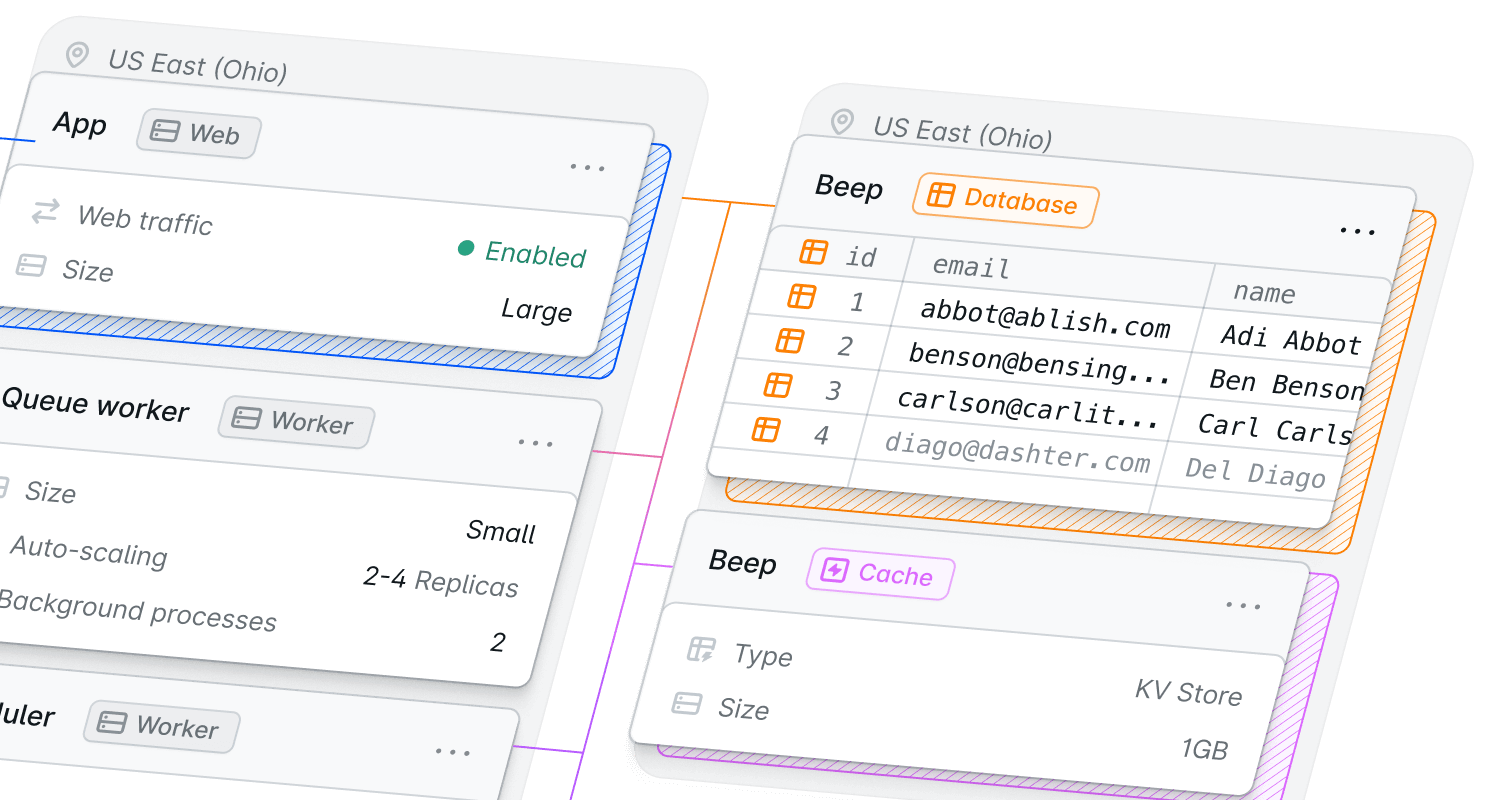
Laravel Cloud is a fully managed hosting platform for Laravel applications that lets teams focus on shipping instead of configuring. It handles web and worker compute, managed databases, and Redis-compatible stores with automatic scaling and hibernation for idle environments to keep costs low.
-
 Push from Git in under a minute and let Cloud handle builds, replicas, and routing.
-
No need to create a separate server account: it’s all built in, from zero-downtime deployments to security (SOC 2 Type 2-compliant).
-
Autoscaling and hibernation reduce manual capacity work, keep performance steady during traffic spikes, and lower idle bills.

Laravel Forge
Laravel Forge is a control plane for provisioning and managing servers at popular cloud providers, such as DigitalOcean, Vultr, Hetzner, AWS, and more. You can also provision instantly with Laravel VPS. Forge automates server setup, installs the required system software, configures web servers and queues, and gives you SSH access for added flexibility.
-
Install and configure SSL, firewall rules, and deployment hooks while retaining server root access.
-
Provision instantly with Laravel VPS, choose a supported server provider, or bring your own server.
-
Forge supports vanilla PHP, WordPress, Statamic, static HTML pages, and other stacks, including Node.js, Nuxt, and Next.js.
Over 20K teams deploy faster with Laravel Cloud



Why Laravel Cloud is better than
Laravel Forge
No infra to manage makes for blazing-fast development teams, as Cloud runs and scales everything.
Built-in databases, cache, and backups are ready instantly, no provider setup required.
Pay only for what you use with automatic hibernation that keeps costs low when apps are idle.
“Laravel Cloud gave us the stability, scalability, and peace of mind we desperately needed. I truly believe Laravel saved both my company and my sanity.”

Sam Pizzo
CEO at CMS Max
Flexibility is good, but productivity is better
Still on the fence between fully managed Laravel hosting with Cloud or flexible server management with Forge?
Read the comparison guide: Laravel Cloud vs. Laravel Forge
Comparing Laravel Cloud vs. Laravel Forge
Laravel Cloud minimizes setup and ongoing operations so teams can launch faster and save on their project’s biggest expense: engineering hours. It’s the best option for scaling Laravel apps. Forge lets you control and customize server instances directly, which is ideal when you need specific system packages, root access, or a custom network setup.
A hosted Laravel platform that delivers managed compute, storage, and data services in a single product, with automatic scaling and optional hibernation to save costs.
A server provisioning and management service that sets up and maintains servers at your chosen provider while giving you full control of the machine and its configuration.
A hosted Laravel platform that delivers managed compute, storage, and data services in a single product, with automatic scaling and optional hibernation to save costs.
A server provisioning and management service that sets up and maintains servers at your chosen provider while giving you full control of the machine and its configuration.
No additional provider account required to use Cloud itself

Requires a cloud provider account or Laravel VPS to provision servers
No additional provider account required to use Cloud itself
Requires a cloud provider account or Laravel VPS to provision servers
Built specifically for Laravel apps
Works for Laravel and other PHP apps, along with Nuxt and Next.js support
Built specifically for Laravel apps
Works for Laravel and other PHP apps, along with Nuxt and Next.js support
Fully managed; you do not manage OS or server instances
You retain SSH/root access and manage OS updates and customizations
Fully managed; you do not manage OS or server instances
You retain SSH/root access and manage OS updates and customizations
Automatic horizontal scaling with replicas and hibernation options
Manual scaling
Automatic horizontal scaling with replicas and hibernation options
Manual scaling
Focus on convenience and predictable operations
Focus on control and deep customization
Focus on convenience and predictable operations
Focus on control and deep customization
Cloud adjusts capacity based on actual traffic and can automatically add or remove replicas to match demand. Environments can be configured to hibernate when unused and wake on request, which reduces costs for intermittent workloads.
Forge provisions servers sized to your needs and lets you scale by resizing instances or adding new machines at your provider. This model gives consistent performance for long-running processes but requires manual scaling or custom automation to handle spikes.
Cloud adjusts capacity based on actual traffic and can automatically add or remove replicas to match demand. Environments can be configured to hibernate when unused and wake on request, which reduces costs for intermittent workloads.
Forge provisions servers sized to your needs and lets you scale by resizing instances or adding new machines at your provider. This model gives consistent performance for long-running processes but requires manual scaling or custom automation to handle spikes.
Fast Git-to-live with platform builds and managed rollouts
Quick to provision via provider APIs but you manage scaling and OS maintenance
Fast Git-to-live with platform builds and managed rollouts
Quick to provision via provider APIs but you manage scaling and OS maintenance
Yes, with replica autoscaling and worker clusters
No built-in automatic horizontal scaling
Yes, with replica autoscaling and worker clusters
No built-in automatic horizontal scaling
Runs on managed EC2 classes for predictable runtime
You control VM types and runtimes so long lived processes are supported (only if using Ubuntu)
Runs on managed EC2 classes for predictable runtime
You control VM types and runtimes so long lived processes are supported (only if using Ubuntu)
Connect your repository, choose a branch and settings, and Cloud runs builds, migrations, and traffic shifting to new replicas so updates deploy without downtime. The platform manages build agents and orchestration.
Forge connects to your Git provider and uses deploy hooks and commands you specify to publish releases to the server. You get fine-grained control over the deployment lifecycle and can run custom provisioning or maintenance steps on the server itself.
Connect your repository, choose a branch and settings, and Cloud runs builds, migrations, and traffic shifting to new replicas so updates deploy without downtime. The platform manages build agents and orchestration.
Forge connects to your Git provider and uses deploy hooks and commands you specify to publish releases to the server. You get fine-grained control over the deployment lifecycle and can run custom provisioning or maintenance steps on the server itself.
Yes, native Git workflow and platform build
Yes, via deploy scripts and quick deploy; you author the commands
Yes, native Git workflow and platform build
Yes, via deploy scripts and quick deploy; you author the commands
Built into the platform via rolling updates and replicas
Supported out of the box, but depends on your configuration (cannot be enabled retroactively for existing apps)
Built into the platform via rolling updates and replicas
Supported out of the box, but depends on your configuration (cannot be enabled retroactively for existing apps)
The Cloud dashboard exposes runtime metrics, request logs, and database telemetry without extra configuration. Security features, including TLS provisioning, edge protections, and backup automation, are managed for you by the platform.
Cloud is SOC2 Type 2 compliant.
Forge provides server metrics, deploy logs, and basic firewall configuration. It automates SSL issuance and can apply recommended firewall rules, but you are ultimately responsible for patching, IAM, and provider-level security controls.
The Cloud dashboard exposes runtime metrics, request logs, and database telemetry without extra configuration. Security features, including TLS provisioning, edge protections, and backup automation, are managed for you by the platform.
Cloud is SOC2 Type 2 compliant.
Forge provides server metrics, deploy logs, and basic firewall configuration. It automates SSL issuance and can apply recommended firewall rules, but you are ultimately responsible for patching, IAM, and provider-level security controls.
Built into the platform view for every environment. Nightwatch integration available
Server level monitoring and logs; integrate third party tools as needed, including Nightwatch
Built into the platform view for every environment. Nightwatch integration available
Server level monitoring and logs; integrate third party tools as needed, including Nightwatch
Managed backups, and point-in-time recovery with Serverless Postgres
Automated backups are available but you’ll have to configure them on your server’s dashboard
Managed backups, and point-in-time recovery with Serverless Postgres
Automated backups are available but you’ll have to configure them on your server’s dashboard
Cloud bills for resources you consume and supports hibernation so compute can pause when idle, reducing baseline costs for spiky workloads (2-3x higher than your average sustained levels). The cost of engineering hours spent managing infrastructure will also be significantly lower.
Calculate your usage and pricing.
Forge charges for the Forge control panel, and you pay your chosen provider separately for server instances, storage, and bandwidth. This model can be cost-effective when you need predictable, always-on instances, but you are responsible for provisioning, infra management, and ongoing server costs.
Cloud bills for resources you consume and supports hibernation so compute can pause when idle, reducing baseline costs for spiky workloads (2-3x higher than your average sustained levels). The cost of engineering hours spent managing infrastructure will also be significantly lower.
Calculate your usage and pricing.
Forge charges for the Forge control panel, and you pay your chosen provider separately for server instances, storage, and bandwidth. This model can be cost-effective when you need predictable, always-on instances, but you are responsible for provisioning, infra management, and ongoing server costs.
Usage based with hibernation to lower idle spend
Forge subscription plus provider bills (flat-rate pricing); provider costs depend on server sizes and region
Usage based with hibernation to lower idle spend
Forge subscription plus provider bills (flat-rate pricing); provider costs depend on server sizes and region
Platform controls autoscale and hibernation settings
You control instance types and autoscaling via your provider tools
Platform controls autoscale and hibernation settings
You control instance types and autoscaling via your provider tools
Start in Cloud with $5 in free usage credit.
No trial available
Start in Cloud with $5 in free usage credit.
No trial available
Who should choose Laravel Cloud vs. Laravel Forge?
Laravel Cloud outperforms Cloudways with faster deployments, autoscaling, and zero server management.
Laravel Cloud
Pick Laravel Cloud when you want minimal setup, automatic scaling, and managed data services so your team can concentrate on product work rather than infrastructure. It is a strong choice for teams who prefer predictable operations and lower ongoing maintenance costs.
Laravel Forge
Pick Laravel Forge if you need full control of your server environment, want root access, or must run custom system software. Forge is suitable when you already manage provider accounts and want a faster path to provision and maintain servers yourself.
Deploy now with Cloud
Start in Cloud with $5 in free usage credit.
-
Launch in under a minute from Git to live with fully managed infrastructure.
-
Build and ship faster with native Laravel integration across your stack.
-
Scale and save costs automatically with built-in auto-hibernation.
Trusted by developers, startups, and enterprises
Join thousands of developers and companies around the world.
“Laravel Cloud makes it easy to demo projects to clients. I can deploy a fresh app in seconds. You only pay for what you use, letting you focus on business value instead of infrastructure.”
Peter Steenbergen
Search & GenAI Specialist, Elastic

“Laravel Cloud has saved us thousands of dollars per month and eliminates the need for a dedicated engineer to monitor our server.”
Sam Pizzo
CEO, CMS Max

“Laravel Cloud is the next generation platform for powering Laravel applications. This is the future of infra for PHP devs.”
Rafael Lunardelli
CTO, Devsquad

“Onboarding was smooth. UI is eye candy. Tinkering with scaling, replicas and resources is seamless.”
Bradley Bernard
Software Engineer, Snap


“Selected my repo, hit deploy, and boom. 60 seconds later my site was ready! I didn’t even have to configure anything.”
Duncan McClean
Software Developer, Statamic

“Wow, Laravel Cloud is very smooth! Took almost no time to deploy a Filament app with database and custom domain.”
Silvan Hagen
Developer & Consultant

“The first deployment is as easy as possible: connect your git, and boom, your page will be online.”
Tim Geisendoerfer
CEO & Founder, Innoge

FAQ: Laravel Cloud vs. Laravel Forge
Laravel Cloud is a fully managed hosting platform for Laravel applications. Forge is a provisioning and management tool that sets up servers at a cloud provider you control and gives you SSH access.
Yes. Cloud supports both database and environment hibernation, so idle resources can be paused to reduce charges.
Forge does not include the same built-in autoscaling and hibernation as Cloud. You manage scaling by resizing instances or configuring your provider’s autoscaling features.
Laravel Cloud runs on AWS, fully managed by the Laravel team. You get the reliability and global scale of AWS without having to create or maintain your own AWS account. All infrastructure is automatically handled for you.
Cloud reduces setup and ongoing operations, so many teams go from repo to production faster. Forge speeds server provisioning compared to manual setup, but you still manage the servers and their lifecycle.
Laravel Cloud offers a usage-based pricing model with automatic hibernation, so you only pay for resources when your app is active. This makes it ideal for keeping traffic spikes under control. Laravel Forge, by contrast, charges a fixed monthly subscription, and you also pay your cloud provider for servers, costs that continue whether the app is idle or not. While Forge’s pricing is more predictable, over time, Cloud often delivers a lower total cost per project because it eliminates ongoing DevOps and server management overhead.